
 Business License

Single vs Twin Blade Disposable Razors: Which One Fits Your Product Line
A distributor in West Africa placed two orders with different suppliers some time ago. One order was for single-blade disposable razors at roughly 4 US cents per unit. The other was for twin-blade models at about 7 cents. The cheaper single-blade units moved slowly. The twin-blade razors sold out within three weeks, and reorders followed. The distributor had assumed that price would be the only factor driving sales in a cost-conscious market. What the sales data revealed was something different: consumers in that region perceived the single-blade razor as too basic, even at the lower price point, while the twin-blade product struck the right balance between affordability and perceived quality. The lesson was clear. In the disposable razor category, blade count does not just affect performance. It shapes consumer perception, determines channel fit, and defines the competitive position of a product line.
This article compares single-blade and twin-blade disposable razors across every dimension that matters for B2B purchasing decisions: performance, cost structure, market demand, application fit, and quality control. By the end, you will have a framework for deciding which format belongs in your product portfolio, or whether both formats have a role to play.
1. Understanding Single-Blade Disposable Razors
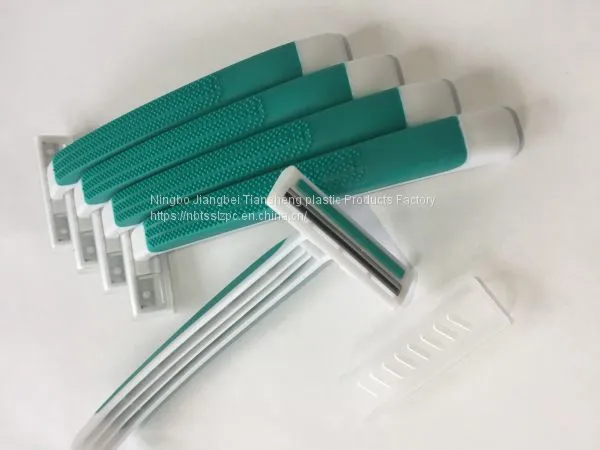
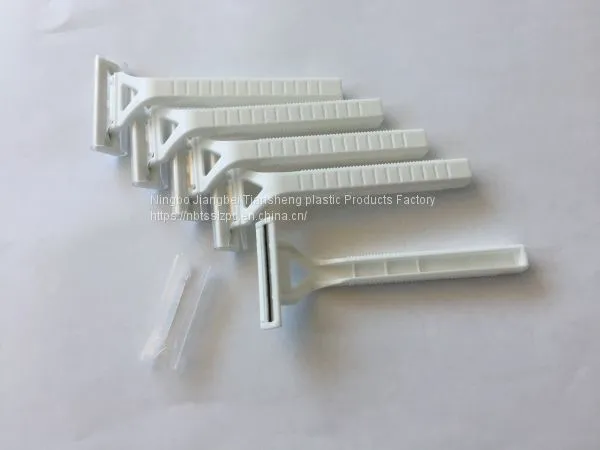
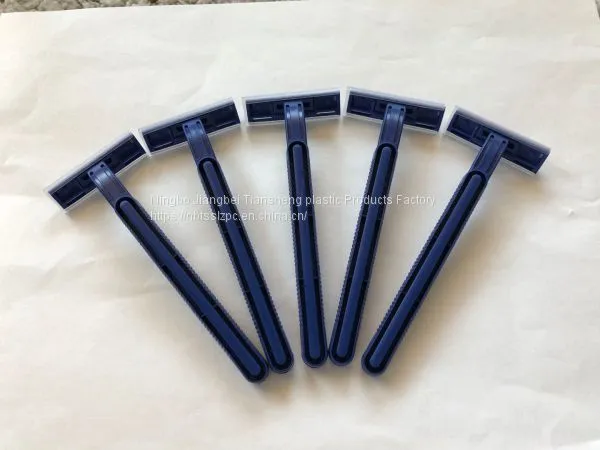
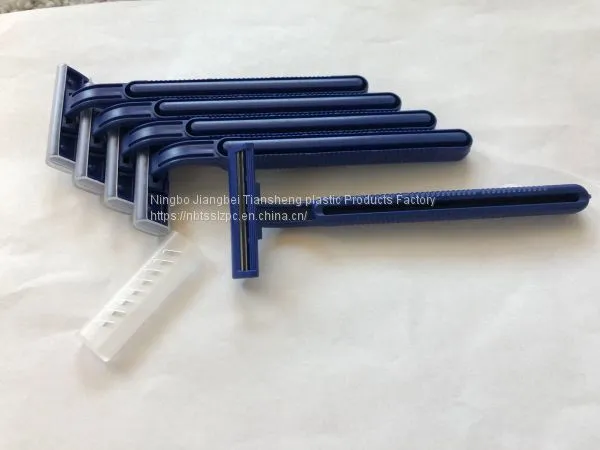
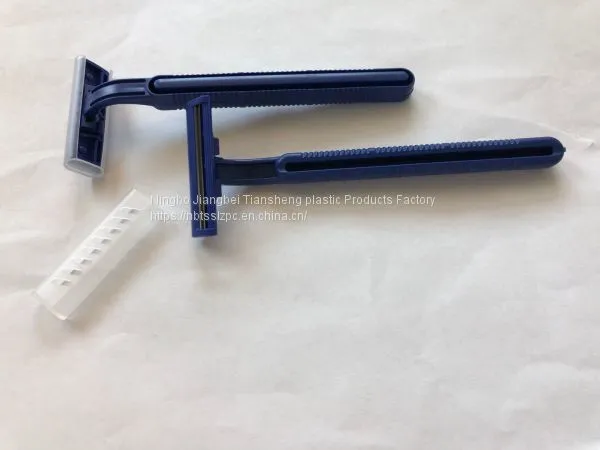
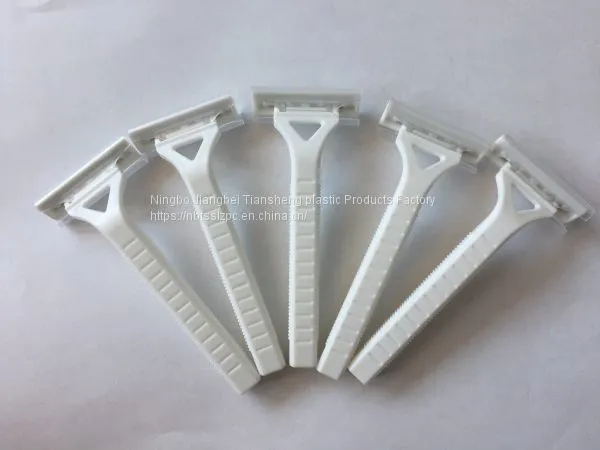
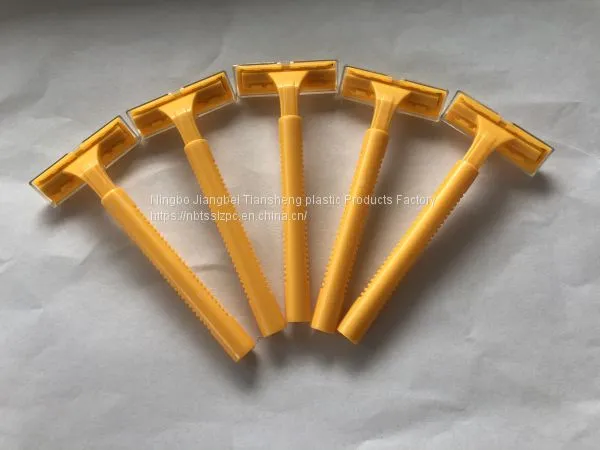
A single-blade disposable razor carries exactly one cutting edge mounted in a fixed plastic head. The construction is about as simple as a shaving product can be: a molded handle, a single steel blade insert, and occasionally a minimal lubricating strip. There is no pivot mechanism, no multi-blade cartridge, and no complex assembly process.
This simplicity translates directly into manufacturing economics. A single-blade razor requires one blade blank, one injection-molded body, and one assembly step. The mold tooling is simpler because there are fewer cavities and no need for precision alignment pins that multi-blade designs require. At the factory level, Ningbo Jiangbei Tiansheng Plastic Products produces single-blade models with cycle times roughly 15 to 20 percent faster than comparable twin-blade units, simply because the assembly process involves fewer stations.
The performance profile of a single-blade razor is straightforward. It cuts hair in one pass per stroke. There is no hysteresis effect because there is no second blade to catch and cut the hair closer to the skin after the first blade lifts it. For light or fine facial hair, a single blade can deliver an acceptable shave. For coarse or dense beards, the user typically needs more strokes, which increases the risk of skin irritation. In B2B terms, this means the single-blade format works for specific use cases but struggles as a general-purpose product across diverse end-user profiles.
2. Understanding Twin-Blade Disposable Razors
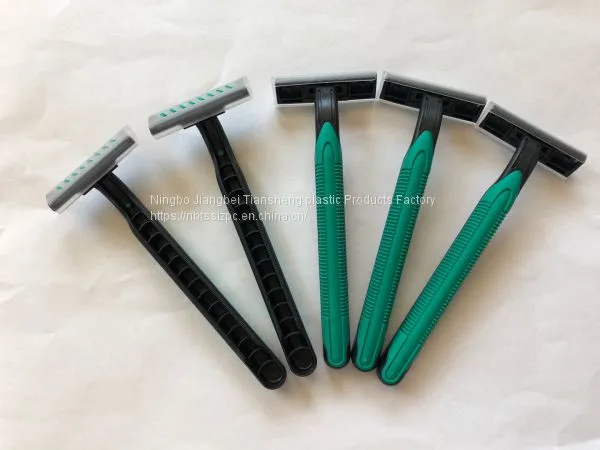
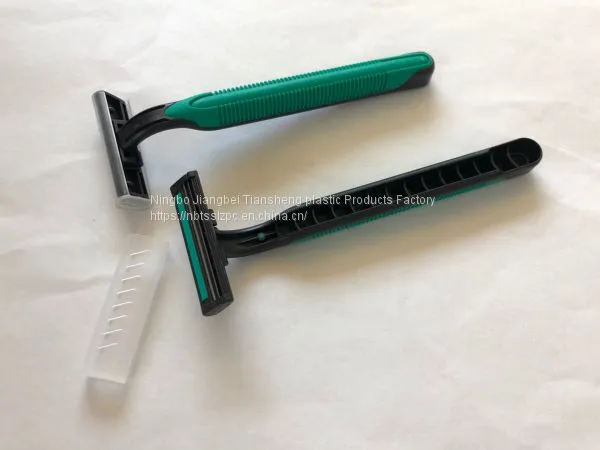
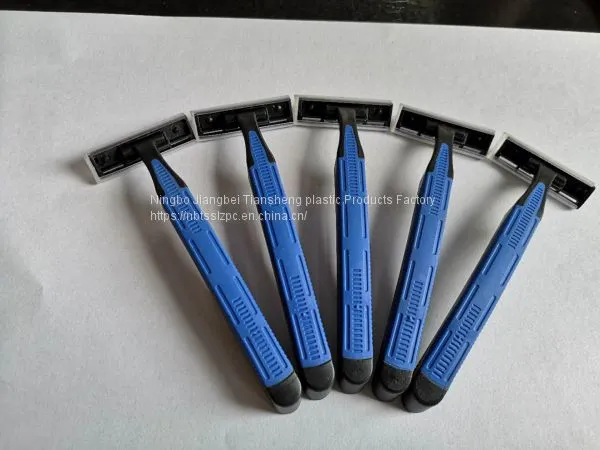
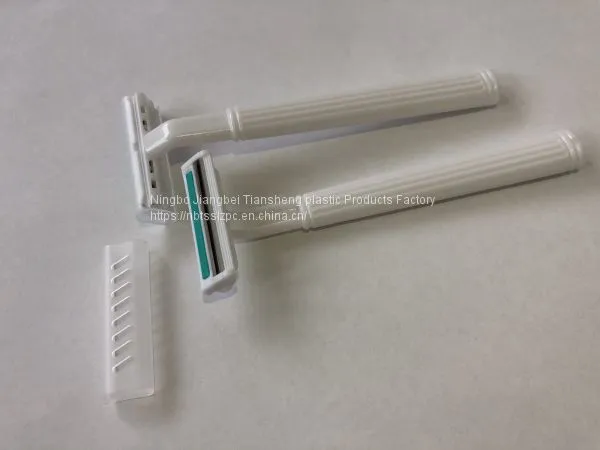
A twin-blade disposable razor positions two blades in sequence within the head assembly. The first blade grazes the skin surface and lifts the hair slightly from the follicle. Before the hair can fully retract, the second blade cuts it at a point closer to the skin. This two-stage cutting dynamic is the defining technical advantage of the twin-blade design over the single-blade format.
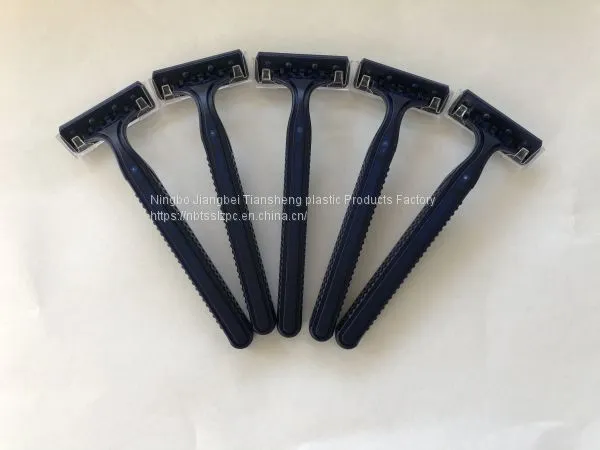
The additional blade introduces several manufacturing considerations. The head housing must hold two blades at precise parallel spacing, typically between roughly 0.5 and 0.8 millimeters apart, with consistent angular alignment across the full width of the cutting edge. The second blade roughly doubles the steel cost for the blade component, though the overall unit cost increase is smaller because the handle and packaging costs remain largely unchanged.
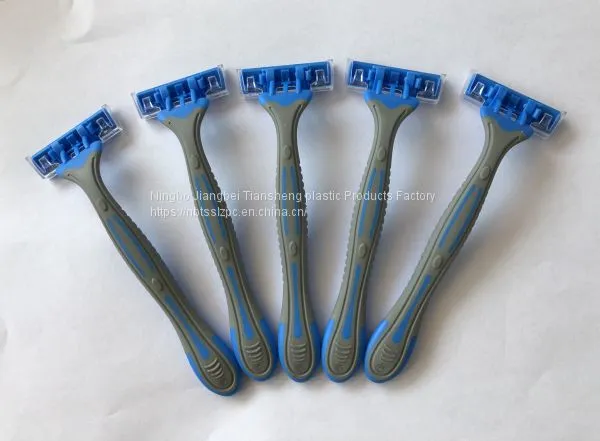
Twin-blade razors dominate the middle of the disposable razor market. They account for roughly 40 to 50 percent of global trade volume in the category, appearing in hotel bathrooms, promotional kits, pharmacy shelves, and supermarket aisles. The format has become the de facto baseline that consumers compare against. A twin-blade razor reads as "normal" to most buyers in most markets, while a single-blade razor reads as "budget" and a triple-blade reads as "premium." This perceptual positioning is one of the strongest commercial arguments for including twin-blade products in a B2B portfolio.
3. Performance: Side-by-Side Comparison
When comparing single-blade and twin-blade performance, the differences fall into four measurable categories: closeness of shave, number of strokes required, skin irritation risk, and user satisfaction ratings.
| Performance Metric | Single Blade | Twin Blade | Practical Impact |
|---|---|---|---|
| Closeness (subjective rating, 1-5) | Roughly 2.5-3.0 | Roughly 3.5-4.0 | Twin-blade users report noticeably smoother results after a single pass |
| Average strokes per shave | Typically 35-50 | Typically 20-30 | Fewer strokes reduce cumulative skin friction and shave time |
| Nick and cut frequency | Higher on curved areas (jaw, chin) | Lower due to distributed cutting pressure | Twin blades reduce point pressure that causes nicks on contours |
| Hair-pulling complaints | More common with coarse hair | Significantly less common | The hysteresis effect reduces tugging on thick beard hair |
| User satisfaction (blind test) | Roughly 55-65% | Roughly 75-85% | In blind tests across markets, twin-blade ratings consistently exceed single-blade by 15-25 points |
The numbers paint a consistent picture. Twin blades deliver objectively better shaving outcomes across every relevant metric. The question for B2B buyers is not whether twin blades perform better. The question is whether the performance gap justifies the cost difference in your specific market and channel.
In some contexts, the answer is no. A single-blade razor in a budget-focused retail environment where the alternative is no razor at all serves a real purpose. In most commercial contexts, however, the step up to twin blades costs roughly 2 to 3 US cents per unit at the wholesale level and delivers a perceptible improvement that drives repeat purchase behavior.
4. Cost Structure: What Drives the Price Gap
The unit cost difference between a single-blade and twin-blade razor is driven by three main factors: blade material, assembly labor, and mold complexity. Understanding each factor helps B2B buyers evaluate whether supplier quotations are reasonable and where cost-saving opportunities exist.
Blade material is the most direct cost driver. A single-blade razor uses one steel blank, while a twin-blade uses two. The steel itself is not a large expense; at roughly 0.3 to 0.5 US cents per blade blank for standard 420-grade stainless, the material cost difference is small. The more meaningful cost comes from blade preparation: each blank must be ground to a precise edge angle, typically 18 to 22 degrees, then coated with a PTFE or ceramic layer to reduce friction. Running two blades through the grinding and coating process doubles the per-unit cost of blade finishing.
Assembly labor adds complexity for twin-blade models. A single-blade razor can be assembled in one station: the blade is inserted into the head housing and secured. A twin-blade razor requires at minimum two insertion steps, often with an intermediate spacer. On a manual assembly line, this adds roughly 30 to 40 percent to the per-unit assembly time.
Mold complexity affects the initial tooling investment rather than the per-unit cost. A twin-blade head mold requires more precise cavity dimensions to hold two blades in consistent alignment. The mold cost for a twin-blade head might run roughly 15 to 20 percent higher than for a single-blade head. For B2B buyers placing large orders, this tooling cost is amortized across the production volume and has minimal impact on unit pricing.
At the ex-factory level, the price difference between a basic single-blade and a basic twin-blade disposable razor typically falls in the range of 2 to 4 US cents per unit for orders of 50,000 pieces or more. For smaller orders, the gap widens because the fixed setup costs distribute across fewer units.
5. Market Demand: Where Each Format Sells
Market demand for single-blade versus twin-blade razors varies significantly by region, channel, and end-use scenario. B2B buyers who understand these demand patterns can align their product selection with actual market pull rather than assumptions.
Single-blade razors find their strongest demand in institutional procurement, emergency relief supply chains, and ultra-budget retail channels. Government tenders for prison supplies, military field kits, and humanitarian aid packages frequently specify single-blade razors because the procurement criteria prioritize unit cost above all other factors. In these channels, the razor functions as a basic hygiene item rather than a grooming product, and the performance expectations are correspondingly low.
Twin-blade razors dominate the commercial channels that most B2B buyers care about: hotel amenities, pharmacy and supermarket retail, promotional product distribution, and duty-free travel retail. In these channels, the end user has a choice. If the razor does not perform adequately, a hotel guest complains, a retail shopper switches brands, or a promotion recipient throws the product away without engaging with the brand message. The modest cost premium for twin blades acts as an insurance policy against these negative outcomes.
Our team at Tiansheng Plastic Products has observed that roughly 70 to 80 percent of inbound inquiries from new buyers specify twin-blade models, even from markets with relatively low average purchasing power. The buyers who request single-blade models almost always represent institutional or aid-agency procurement rather than commercial distribution. This pattern has held consistently across several years of customer interactions and reflects a structural preference in the market rather than a temporary trend.
6. Application Fit: Matching Blade Count to End Use
The following table maps common B2B applications to the recommended blade count, along with the reasoning behind each recommendation.
| Application | Recommended Blade Count | Reasoning |
|---|---|---|
| Hotel guest amenity | Twin blade | Guest expectations: basic but functional. Single blade risks complaints; triple blade adds unnecessary cost for a one-use item. |
| Promotional giveaway | Twin blade | Brand perception: a cheap razor reflects poorly on the brand giving it away. Twin blade signals competence without premium pricing. |
| Pharmacy/supermarket retail | Twin blade (entry), Triple (premium) | Single blade cannot compete on shelf against branded alternatives. Twin is the minimum viable retail format. |
| Institutional (prison, military) | Single blade | Cost-dominant procurement. Performance is secondary to price and basic hygiene compliance. |
| Humanitarian aid kit | Single blade | Budget constraints and volume requirements dominate. The razor serves a basic sanitation function. |
| Travel retail / duty-free | Twin blade minimum, triple preferred | Travelers expect a product that performs comparably to what they use at home. Single blade would disappoint. |
| Private label retail brand | Twin blade minimum | A private-label product must match or exceed the quality perception of competing branded products on the same shelf. |
The pattern is clear: single-blade razors belong in cost-driven, non-commercial procurement channels where the end user does not choose the product. Twin-blade razors belong in every channel where end-user satisfaction affects repeat business, brand reputation, or guest experience metrics.
7. Quality Trade-offs by Blade Count
Fewer blades do not automatically mean lower quality, but the quality margin for error is narrower with a single-blade design. A single blade must be sharp, correctly angled, and free of burrs, because there is no second blade to compensate for a cutting deficiency. Our factory applies the same incoming steel inspection standards to single-blade and twin-blade raw materials, but the consequences of a borderline-quality blade are more visible in a single-blade product.
Lubricating strip quality matters more for single-blade razors for a similar reason. Without the friction distribution that a second blade provides, a single-blade razor relies more heavily on the lubricating strip to reduce drag. A poorly formulated or inadequately bonded strip on a single-blade razor leads to a rough, uncomfortable shave that the user feels immediately. On a twin-blade razor, the same strip deficiency is partially masked by the smoother cutting action of the dual-blade system.
Handle durability requirements do not differ significantly between the two formats. Both single and twin-blade models use similar polypropylene or rubber-overmolded handle constructions, and the mechanical stresses during shaving are comparable. Buyers should apply the same handle-quality benchmarks regardless of blade count.
Not long ago, a buyer in Eastern Europe evaluated samples from several suppliers and initially selected a single-blade model based on price. Ningbo Jiangbei Tiansheng Plastic Products provided both single and twin-blade samples for the evaluation. After receiving feedback from a user test panel, the buyer switched to the twin-blade model. The panel rated the single-blade samples as "acceptable" but the twin-blade as "would buy again." The buyer's retail channel depended on repeat purchases from budget-conscious consumers, and the data suggested that a 2-cent savings on unit cost would translate into lost repeat business. The twin-blade order went through, and the reorder came roughly six weeks after the first shipment arrived at retail.
8. Making the Right Choice for Your Product Line
The decision between single-blade and twin-blade disposable razors reduces to three questions. First, does your end user choose the product, or is it issued to them? If the end user chooses, twin blade is the safer bet in virtually every market. If the product is issued through institutional channels, single blade may be sufficient.
Second, what is the consequence of a dissatisfied user? In a hotel, a dissatisfied guest leaves a negative review or asks the front desk for a different amenity. In retail, a dissatisfied shopper switches brands. In both cases, the commercial cost of dissatisfaction outweighs the incremental cost of a second blade. In an institutional setting, user satisfaction is typically not measured, so the calculus shifts toward cost minimization.
Third, what are your competitors offering in the same channel? If competing products on the same shelf or in the same hotel amenity kit carry two blades, a single-blade product looks deficient by comparison regardless of its actual functional performance. Perception drives purchase decisions in consumer goods, and blade count is a highly visible proxy for quality that shoppers use to make snap judgments.
For most B2B buyers reading this, the answer to all three questions points toward twin-blade as the core product format, with single-blade reserved for specific institutional contracts where the procurement terms explicitly demand the lowest possible unit price.
9. FAQ
9.1 Is there any scenario where a single-blade razor actually performs better than a twin-blade?
In terms of shaving performance, no. The hysteresis effect of twin blades consistently produces a closer shave with fewer strokes. However, single-blade razors have one practical advantage: they are easier to rinse clean because there is no space between blades where hair and shaving cream can become trapped. For users shaving in conditions with limited water access, this can be a meaningful convenience factor. For most commercial applications, though, the twin-blade performance advantage overshadows this single maintenance benefit.
9.2 How much more does a twin-blade razor cost compared to a single-blade at wholesale?
The wholesale price difference typically ranges from roughly 2 to 4 US cents per unit for orders of 50,000 pieces or more, depending on handle material, packaging, and whether a lubricating strip is included. If a basic single-blade razor costs roughly 4 cents ex-factory, a comparable twin-blade model might cost 6 to 8 cents. The exact gap varies by supplier and specifications. Buyers should request quotations for both formats from the same supplier to get an accurate comparison rather than comparing prices across different factories.
9.3 Can a supplier produce both single and twin-blade razors on the same production line?
Most experienced manufacturers can produce both formats, though not simultaneously on the same assembly line. The head molds and blade-insertion fixtures are format-specific, so switching requires a mold change and fixture reconfiguration. At our facility, the changeover between single and twin-blade production typically takes a few hours. For B2B buyers, this means they can source both formats from the same supplier, gaining consistency in quality standards and simplifying supplier management.
Recently Posted
-
Ningbo Jiangbei Tiansheng Plastic Products Factory: Three Decades of Disposable Razor Manufacturing
August 17, 2026In 1996, a plastic products factory opened its doors in the Hongtang area of Ningbo's Jiangbei District, in Zhejiang province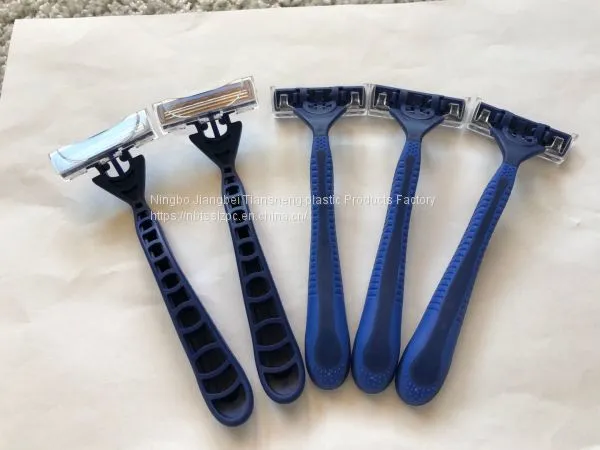 Read More
 -
Disposable Razors for Hotels: Procurement Guide for Hospitality Buyers
August 14, 2026A mid-range hotel chain in Southeast Asia received a series of guest complaints some time ago. The issue was not the room cleanlin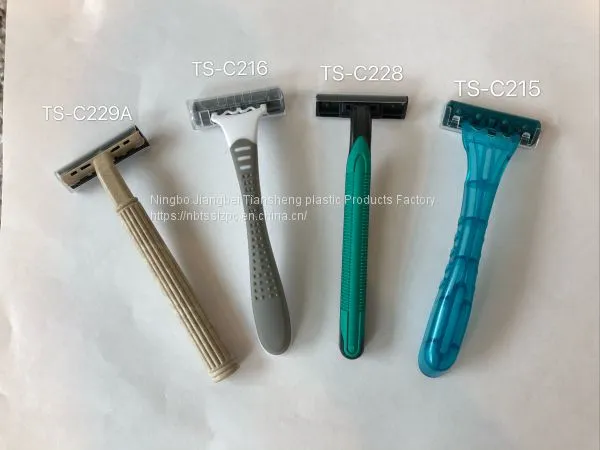 Read More
 -
How to Choose a Disposable Razor Manufacturer in China: A Step-by-Step Guide
August 13, 2026An importer based in South America spent roughly six months sourcing disposable razors from China some time ago. He contacted elev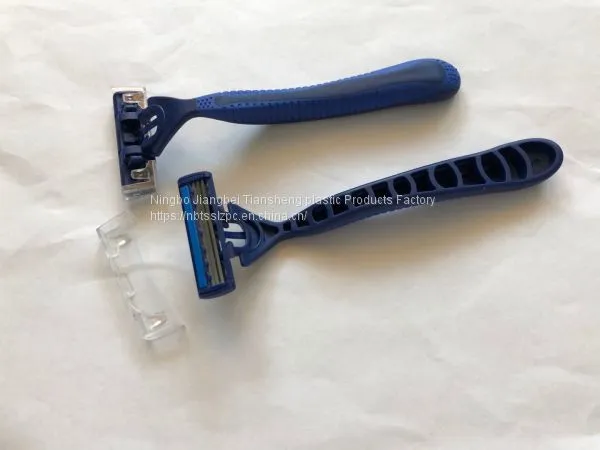 Read More
 -
What Is a Disposable Razor: A Complete Introduction for B2B Buyers
August 11, 2026A distributor in Eastern Europe placed an order for roughly 50,000 disposable razors some time ago. The shipment arrived on schedu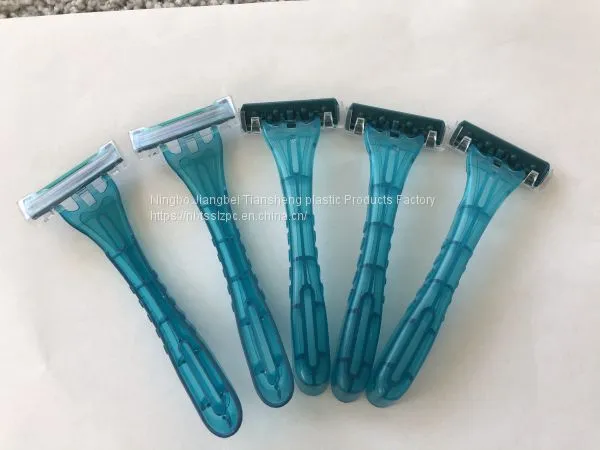 Read More

Contact Us
Recommended Products
-
 TS-C229-A Disposable Razor Male FemaleNegotiableMOQ: 10000 Pieces
 -
TS-C228 Disposable RazorNegotiableMOQ: 10000 Pieces
-
TS-C239 Disposable RazorNegotiableMOQ: 10000 Pieces
-
TS-C205 Disposable Razor With Two BladeNegotiableMOQ: 10000 Pieces
-
TS-C229A Disposable Razor ShaverNegotiableMOQ: 10000 Pieces
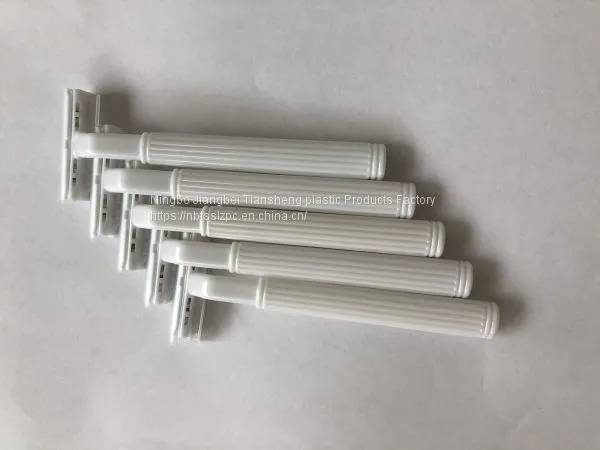
-
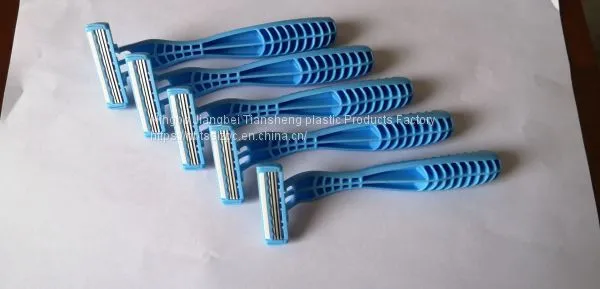
Disposable RazorNegotiableMOQ: 100 Pieces
-
TS-C216 Disposable Razor Personal CareNegotiableMOQ: 10000 Pieces
-
TS-C228 Disposable Razor ShaverNegotiableMOQ: 10000 Pieces
-
TS-212 Disposable Razor With Two BladeNegotiableMOQ: 10000 Pieces
-
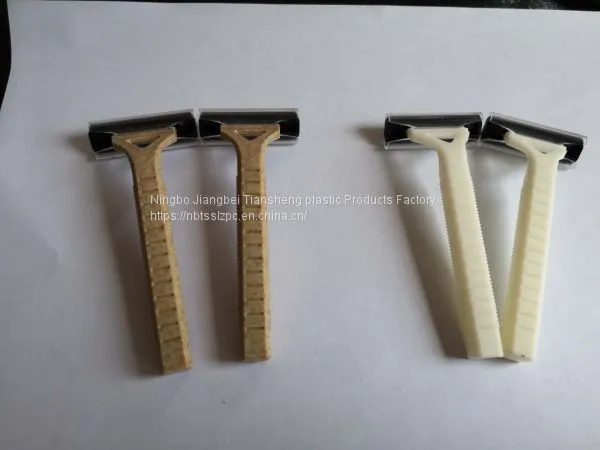
TS-C229-A Eco-Friendly Disposable Shaving Razor Male FemaleNegotiableMOQ: 10000 Pieces
-
TS-C232 Disposable Hotel Shaving RazorNegotiableMOQ: 10000 Pieces
-
TS-C236 Eco-friendly Straw 2 Blade Shavers Wholesale Hotel Disposable RazorNegotiableMOQ: 10000 Pieces
-
TS-C209A Disposable Razor Shaver Four BladeNegotiableMOQ: 10000 Pieces
-
5-pc Disposable Razor ShaverNegotiableMOQ: 10000 Pieces
-
TS-C219 Eco Friendly Safety Wheat Straw Lady Men Hotel Travel Shaver Disposable RazorNegotiableMOQ: 10000 Pieces