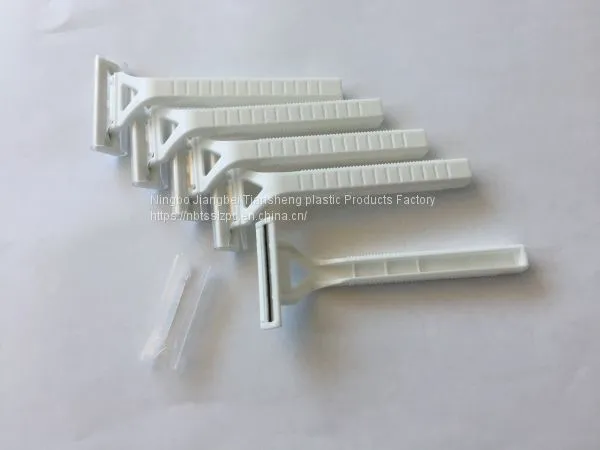

 Business License

How Disposable Razors Are Made: A Complete Manufacturing Guide
A few seasons ago, a distributor in Southeast Asia received a container of disposable razors that looked correct from the outside. The polybags were sealed, the blister cards were printed, and the cartons matched the packing list. Inside, however, the blade edge angle was off across the batch because the grinding station had drifted out of tolerance. Customers complained of tugging within days of the stock reaching retail shelves.
The entire shipment had to be discounted and reworked at the distributor's expense. That incident cost the buyer roughly three times the original container value in returns and lost channel trust. Understanding how disposable razors are actually made would have flagged the risk before the order shipped.
For B2B buyers, the manufacturing process is not an abstract detail. Every stage, from steel specification to final inspection, determines whether a product will perform in the market or create a liability. This guide walks through the production line step by step, explains what happens at each stage, and highlights the control points that separate a reliable factory from a risky one. Ningbo Jiangbei Tiansheng Plastic Products Factory operates this full process in its facility in Ningbo, China, and the description below reflects how a professional disposable razor plant organizes the work.
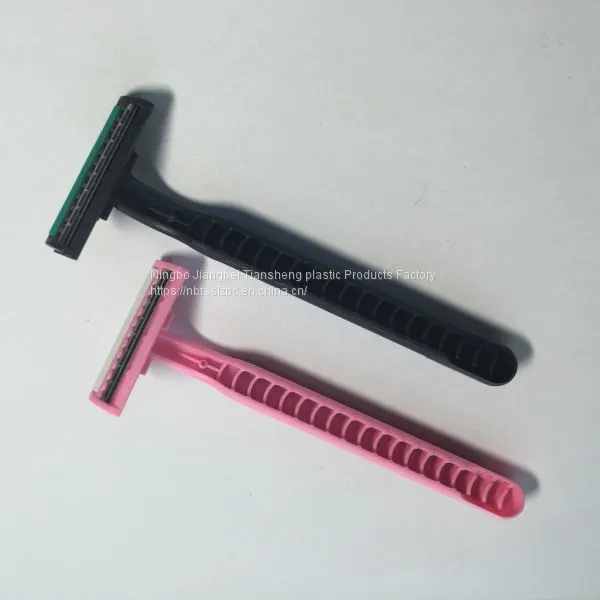
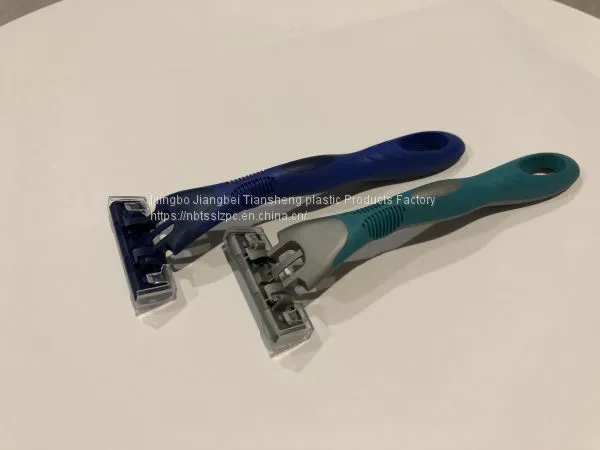
1. From Raw Materials to Finished Product: The Big Picture
A disposable razor begins as two main material families: metal for the cutting blades and plastic for the handle and head housing. Between those raw inputs and the sealed polybag lies a chain of roughly a dozen distinct operations, each with its own equipment, tolerances, and failure modes.
Blades are produced from high-carbon stainless steel strip, typically 0.08 to 0.12 millimeters thick, supplied in coils. Handles are molded from polypropylene pellets, and the lubricating strip is a water-soluble polymer blend applied to the head. The assembly stage joins these components, and the finished product then moves through packaging and inspection.
The following table summarizes the main stages, typical cycle times, and the critical parameter at each step. It is the same outline a factory engineer would draw on a whiteboard during a plant tour.
| Stage | Typical Cycle or Output | Critical Parameter |
|---|---|---|
| Steel slitting and stamping | 40–80 blades per minute per press | Edge geometry consistency |
| Grinding and sharpening | 8–15 seconds per blade pass | Edge angle, micro-chipping |
| Edge coating | In-line, continuous | Coating thickness uniformity |
| Handle injection molding | 25–45 seconds per cycle | Dimensional stability, sink marks |
| Assembly | 30–60 units per minute | Blade alignment, head lock |
| Lubricating strip application | In-line during assembly | Adhesion and activation time |
| Packaging | 60–120 packs per minute | Seal integrity, count accuracy |
| Outgoing inspection | Sampling per batch | Conformance to approved sample |
The sequence matters as much as the individual operations. A defect introduced at the stamping stage, for example, cannot be repaired later; it can be detected and scrapped, nothing more. That is why experienced factories concentrate inspection effort early in the line rather than waiting until finished razors reach the packing table.
2. Blade Production: From Steel Coil to Cutting Edge
Blade manufacturing begins with high-carbon stainless steel strip chosen for its ability to hold a fine edge. Common grades include martensitic stainless steels that harden through heat treatment. The strip arrives in coils and is first slit to the correct width for the razor head format being produced.
Stamping presses then blank out individual blade blanks, complete with the mounting holes and locating tabs that will position the blade inside the head housing. A single press stroke can produce one or two blanks, and presses run continuously through a shift. The stamped blanks are then heat-treated to achieve the hardness needed for a durable edge, typically in the range of 500 to 620 HV depending on the steel grade and target performance.
Grinding is the operation that separates a functional blade from a decorative piece of metal. The cutting edge is ground to a wedge profile with an included angle that typically falls between 15 and 20 degrees. The grind must be uniform across the full blade length; a variance of even a few micrometers changes how the edge contacts the skin and how easily it cuts hair.
After grinding, the edges are coated with a thin polymer layer that reduces friction during the shave. This coating, often based on polytetrafluoroethylene or a similar low-friction compound, is what makes the blade glide rather than drag. The coating is applied in a controlled process and its thickness directly affects perceived sharpness and comfort.
3. Handle Molding: Shaping the Grip
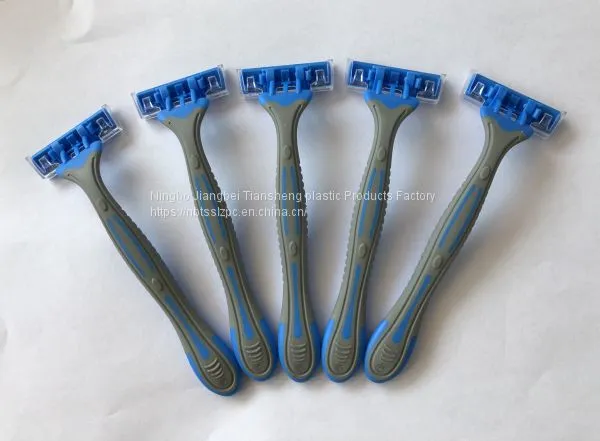
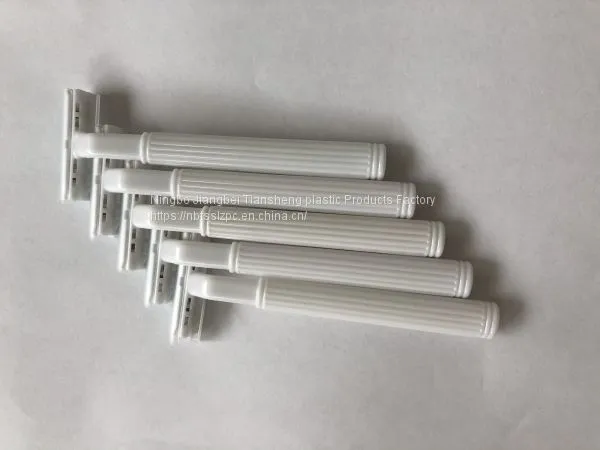
The handle and head housing are produced by injection molding. Polypropylene is the standard material because it offers a good balance of rigidity, chemical resistance, and cost. The pellets are dried, melted, and injected into a steel mold under high pressure, where they cool and solidify into the finished shape.
Cycle times for a typical razor handle range from 25 to 45 seconds, depending on wall thickness and mold complexity. A single mold may have 8, 16, or 32 cavities, meaning each cycle produces multiple handles at once. This is where economies of scale come from: a 32-cavity mold running a 30-second cycle can output more than 3,800 handles per hour.
Mold quality is a decisive factor in product consistency. A well-made mold produces parts that mate cleanly with the blade assembly, while a poorly maintained mold produces flash, sink marks, or warpage. Ningbo Jiangbei Tiansheng Plastic Products Factory maintains its own tooling and runs regular mold maintenance to keep dimensional drift in check across long production runs.
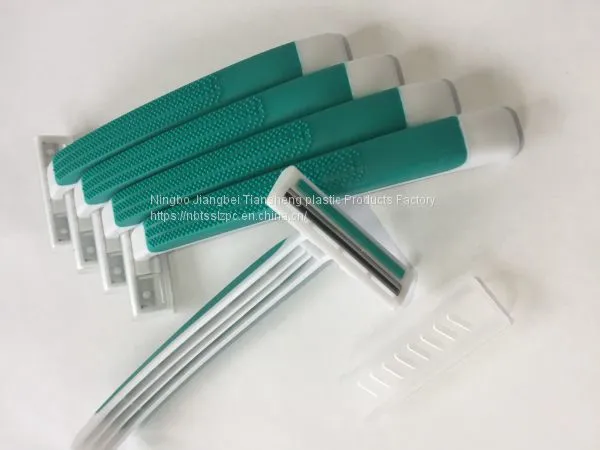
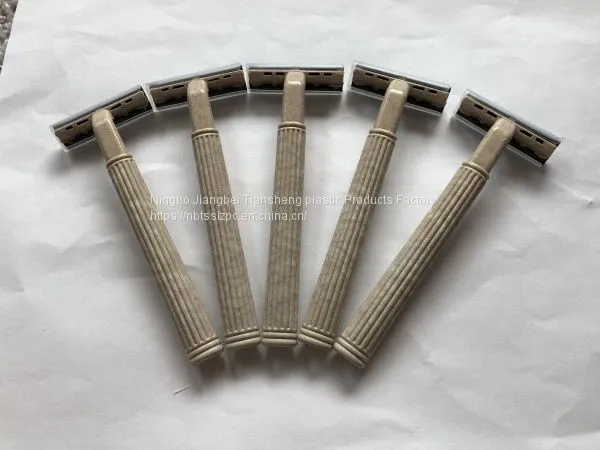
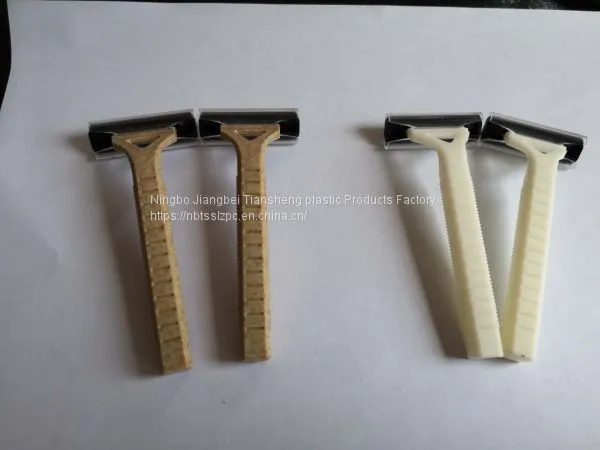
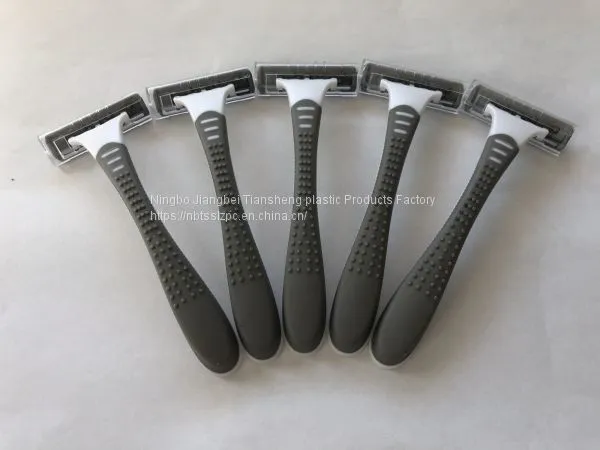
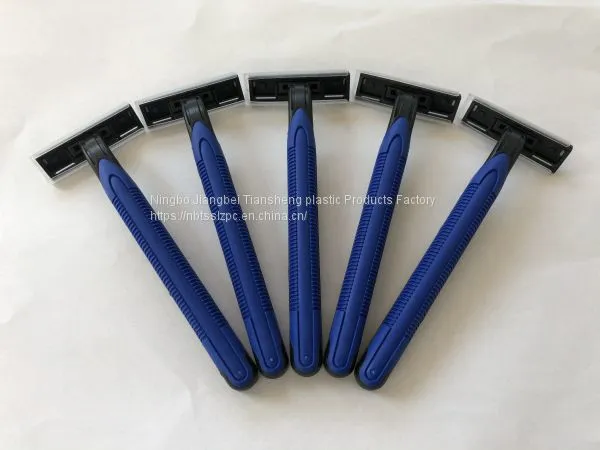
For specialized lines, the handle material can change. Wheat-straw composite handles blend agricultural fiber with polypropylene to reduce virgin plastic content. Rubber-overmolded handles add a soft-touch layer over the rigid core. These variants use the same molding machinery with modified process parameters, which is why a single factory can offer a broad handle portfolio without duplicating its equipment.
4. Assembly: Joining Blade and Handle
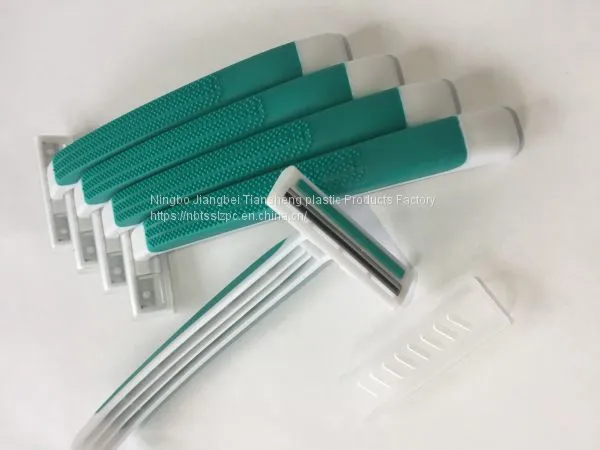
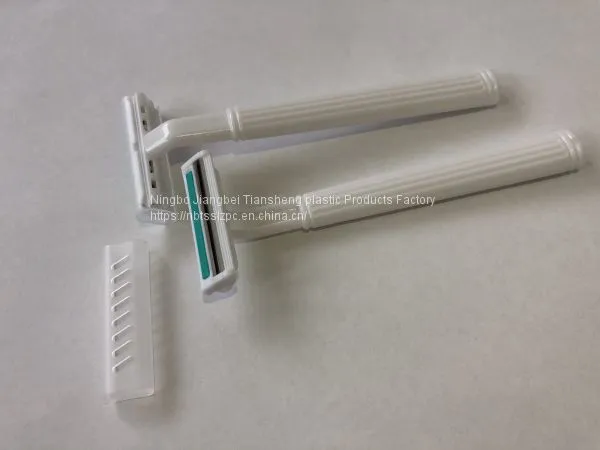
Assembly is where the blade meets the housing. On a manual line, workers place each blade into the head housing, add spacers between blades in multi-blade formats, and snap the assembly closed. On a semi-automated line, feeders position the blades and a pressing station closes the head, with operators handling inspection and packing.
Blade alignment is the single most important quality variable at this stage. In a twin-blade razor, the two edges must sit at precise angles relative to the skin plane, typically with a defined blade gap and exposure. A misalignment of a fraction of a millimeter creates uneven cutting pressure that the user experiences as pulling or irritation.
The handle-to-head attachment is equally critical. The joint must withstand bending forces well beyond anything encountered in normal shaving, because a razor that separates in use is a safety hazard. Pull-test fixtures measure the force required to detach the head, and factories track these values across batches.
Production speed at assembly depends on the blade count and head complexity. Simple single-blade razors assemble faster than four-blade pivoting models. Typical lines run at 30 to 60 units per minute, and output per shift ranges from roughly 15,000 to 30,000 pieces depending on format and staffing.
5. Lubricating Strips and Comfort Features
The lubricating strip is a small polymer block mounted on the head housing, designed to release a lubricating agent gradually as it wets during shaving. Its formulation includes water-soluble polymers, moisturizers, and sometimes aloe or vitamin additives depending on the product grade.
The strip must activate at the right pace. A strip that dissolves too quickly provides little benefit beyond the first seconds of the shave. A strip that never releases its agents is equally useless. Manufacturers control this by adjusting the polymer blend and the strip geometry, and quality checks verify activation behavior on a sampling basis.
Pivoting heads add a spring-loaded mechanism between the handle and the blade carrier, allowing the head to follow the contours of the face. The spring rate and pivot range are engineered parameters; a head that pivots too freely feels unstable, while one that is too stiff defeats the purpose. These mechanisms add assembly complexity and slightly reduce line speed, which is why pivoting models carry a higher unit cost.
6. Packaging and Finished-Goods Handling
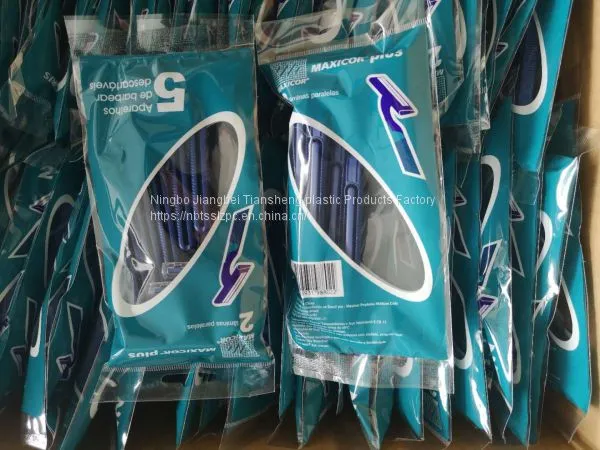
Packaging formats range from bulk polybags for hotel supply to blister cards for retail shelves. The packaging line applies the format specified by the buyer, including any printed branding, and seals the product for shipment.
Polybag packing is the most economical option for bulk supply. Razors are counted, placed into sealed bags, and packed into cartons. Count accuracy matters: a shipment that under-delivers on count creates immediate disputes. Automated counting scales and periodic manual recounts keep accuracy in check.
Blister packaging involves a thermoformed plastic bubble and a printed card. The process is slower and costlier per unit, but it is required for self-service retail. Packaging graphics are applied by the factory using the buyer's artwork, and color accuracy is checked against an approved proof before mass production begins.
Finished cartons are palletized and staged for inspection. Moisture control is important at this point because the lubricating strips and steel edges can degrade if finished goods sit in humid conditions for extended periods. Warehousing in a dry, ventilated area is standard practice at professional facilities.
7. Quality Control Points Along the Line
Quality control in a disposable razor plant is distributed across the process rather than concentrated at the end. Incoming material inspection verifies that steel coils, plastic pellets, and packaging components meet specifications before production. In-process checks sample blade geometry, handle dimensions, and assembly alignment at defined intervals.
Final outgoing inspection examines finished products for cosmetic defects, packaging integrity, and functional performance. Sampling follows an AQL-based plan, and any batch that exceeds the acceptable defect threshold is held for screening or rework. Defect data is logged and reviewed to identify recurring issues that point to a process problem rather than random variation.
For buyers, the practical question is whether a factory can show its control points and explain the pass-fail criteria at each one. A factory that documents its checks and can produce records is more likely to ship consistent product than one that relies on informal visual inspection. The QC team at Ningbo Jiangbei Tiansheng Plastic Products Factory operates full-time and independently of the production team, so inspection decisions are not influenced by output pressure.
8. Automation vs Manual Assembly: What Buyers Should Expect
Disposable razor production exists on a spectrum from fully manual to largely automated. Most Chinese factories operate a hybrid: automated stamping, grinding, and molding, with semi-automated assembly and manual packaging for certain formats. The choice affects cost, consistency, and flexibility.
Automated lines deliver higher consistency because the process parameters are machine-controlled. They also require larger order volumes to justify the tooling investment. Manual or semi-automated lines offer flexibility for small runs, custom formats, and products that change frequently, at the cost of more variable quality that must be caught by inspection.
Buyers should match the production model to their order profile. A steady buyer ordering 100,000 units of a standard twin-blade razor every month benefits from automated capacity. A buyer ordering 10,000 units of a customized promotional razor may be better served by a flexible line where changeovers are fast. Discussing production capacity and line configuration during sourcing prevents mismatched expectations later.
9. Lead Times and Production Planning
Production lead time for standard disposable razors typically runs 15 to 30 days for orders of 50,000 to 200,000 pieces, depending on the factory's current schedule. Custom orders with new molds or branded packaging extend this to 30 to 45 days because tooling and artwork approval add stages before production can start.
Raw material procurement is the hidden variable in lead times. Steel and plastic resin are usually stocked by the factory, but specialty materials such as wheat-straw composite or custom coating formulas may need to be ordered, adding a week or more. Buyers who lock in material specifications early avoid surprises.
Seasonal demand also shapes production planning. Demand for disposable razors typically rises ahead of peak travel seasons and major promotional periods. Factories fill capacity several weeks in advance during these windows, so buyers with fixed launch dates should place orders early and confirm production slots rather than assuming capacity will be available on demand.
10. Frequently Asked Questions
10.1 How long does it take to manufacture a disposable razor?
The physical production of a single disposable razor, from steel coil and plastic pellets to a sealed polybag, takes a few seconds of machine time when measured per unit. The more relevant number is batch lead time, which covers raw material staging, molding, assembly, inspection, and packaging. For a standard order, production typically completes in 15 to 30 days, with customs and shipping time on top of that. Custom products with new tooling take longer because the mold itself must be manufactured and trialed before mass production begins.
10.2 What steel is used for disposable razor blades?
Most disposable razor blades use high-carbon stainless steel that can be hardened by heat treatment. The steel is supplied as thin strip, typically 0.08 to 0.12 millimeters thick, and is stamped, heat-treated, ground, and coated during production. The specific grade affects edge retention and corrosion resistance.
Budget razors may use lower-grade steel with a shorter effective edge life, while premium formats use higher-grade steel with refined grinding. Buyers can request material certificates to confirm the grade used in a specific batch.
10.3 Can a factory produce custom handles and packaging?
Yes, custom handles and packaging are standard services at established factories. Custom handle shapes require a new injection mold, which carries a one-time tooling cost and adds lead time. Custom packaging requires artwork approval and printed materials.
Ningbo Jiangbei Tiansheng Plastic Products Factory supports both, and buyers typically start with a sample or small trial run before committing to a large custom order. The practical threshold for custom tooling investment is usually around 30,000 to 50,000 units per SKU, depending on the complexity of the design.
10.4 How can a buyer verify production quality without visiting?
A buyer can verify quality through several remote methods. Requesting production samples and running a structured shave test provides direct feedback. Asking for photos or video of the assembly line and inspection stations confirms the factory's setup. Reviewing QC records and defect-tracking data shows whether the factory measures its own performance.
For larger orders, many buyers arrange a third-party inspection company to audit production before shipment. The combination of samples, documentation, and independent inspection covers most of the information a factory visit would provide.
Recently Posted
-
Ningbo Jiangbei Tiansheng Plastic Products Factory: Three Decades of Disposable Razor Manufacturing
August 17, 2026In 1996, a plastic products factory opened its doors in the Hongtang area of Ningbo's Jiangbei District, in Zhejiang province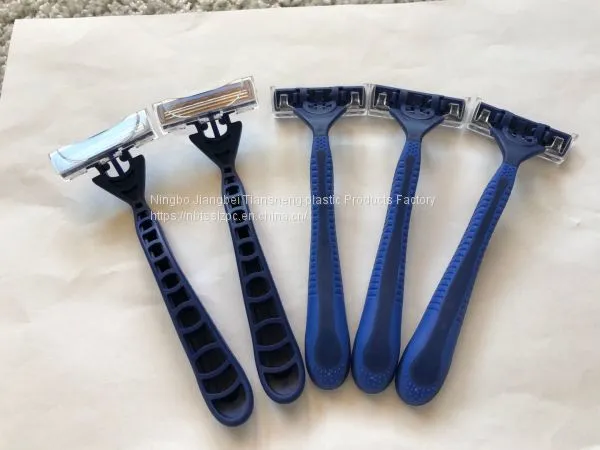 Read More
 -
Disposable Razors for Hotels: Procurement Guide for Hospitality Buyers
August 14, 2026A mid-range hotel chain in Southeast Asia received a series of guest complaints some time ago. The issue was not the room cleanlin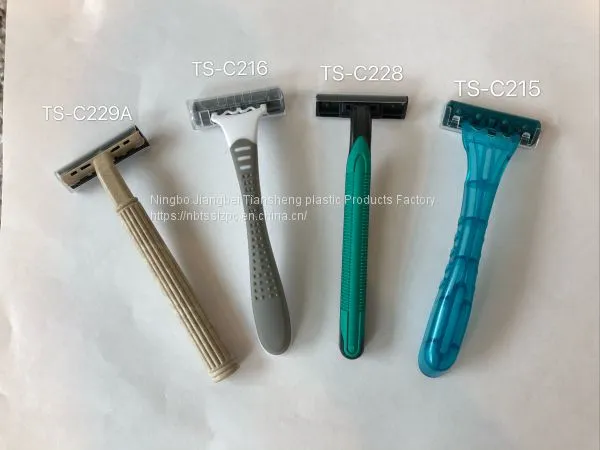 Read More
 -
How to Choose a Disposable Razor Manufacturer in China: A Step-by-Step Guide
August 13, 2026An importer based in South America spent roughly six months sourcing disposable razors from China some time ago. He contacted elev Read More
 -
Single vs Twin Blade Disposable Razors: Which One Fits Your Product Line
August 12, 2026A distributor in West Africa placed two orders with different suppliers some time ago. One order was for single-blade disposable r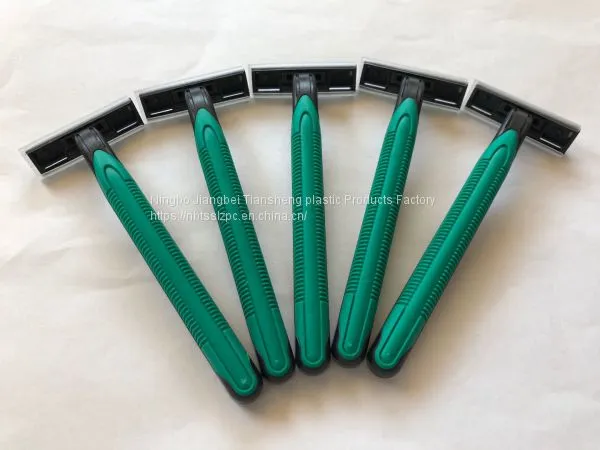 Read More

Contact Us
Recommended Products
-
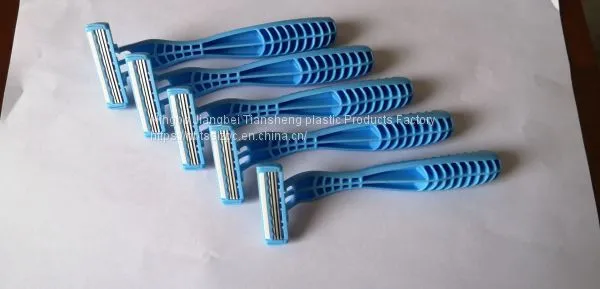
 TS-C229-A Disposable Razor Male FemaleNegotiableMOQ: 10000 Pieces
 -
TS-C228 Disposable RazorNegotiableMOQ: 10000 Pieces
-
TS-C239 Disposable RazorNegotiableMOQ: 10000 Pieces
-
TS-C205 Disposable Razor With Two BladeNegotiableMOQ: 10000 Pieces
-
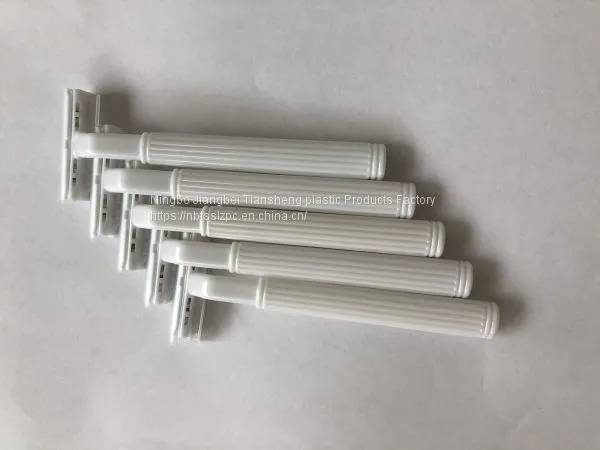
TS-C229A Disposable Razor ShaverNegotiableMOQ: 10000 Pieces
-
Disposable RazorNegotiableMOQ: 100 Pieces
-
TS-C216 Disposable Razor Personal CareNegotiableMOQ: 10000 Pieces
-
TS-C228 Disposable Razor ShaverNegotiableMOQ: 10000 Pieces
-
TS-212 Disposable Razor With Two BladeNegotiableMOQ: 10000 Pieces
-
TS-C229-A Eco-Friendly Disposable Shaving Razor Male FemaleNegotiableMOQ: 10000 Pieces
-
TS-C232 Disposable Hotel Shaving RazorNegotiableMOQ: 10000 Pieces
-
TS-C236 Eco-friendly Straw 2 Blade Shavers Wholesale Hotel Disposable RazorNegotiableMOQ: 10000 Pieces
-
TS-C209A Disposable Razor Shaver Four BladeNegotiableMOQ: 10000 Pieces
-
5-pc Disposable Razor ShaverNegotiableMOQ: 10000 Pieces
-
TS-C219 Eco Friendly Safety Wheat Straw Lady Men Hotel Travel Shaver Disposable RazorNegotiableMOQ: 10000 Pieces